


Location & geography
Slovenia is a central European country. It covers an area of 20.273 km2 and borders Italy, Austria, Hungary and Croatia. It also lies on the coast of the Adriatic Sea. The coastline is 46,6 km long. It has remarkable regional diversity: The Alps (30% of the area), the Dinaric karst region (30%), the Mediterranean (10%) and the Pannonian Basin (30%). Slovenia boasts the highest density of caves in the world. Karst characteristics represent 44% of the country`s territory. Slovenia is also one of the most forested countries in Europe (60% of the area is covered by forests). Our highest peak is Triglav (2864 m). Slovenia has a population of little more than 2 million.
Traffic communications & driving
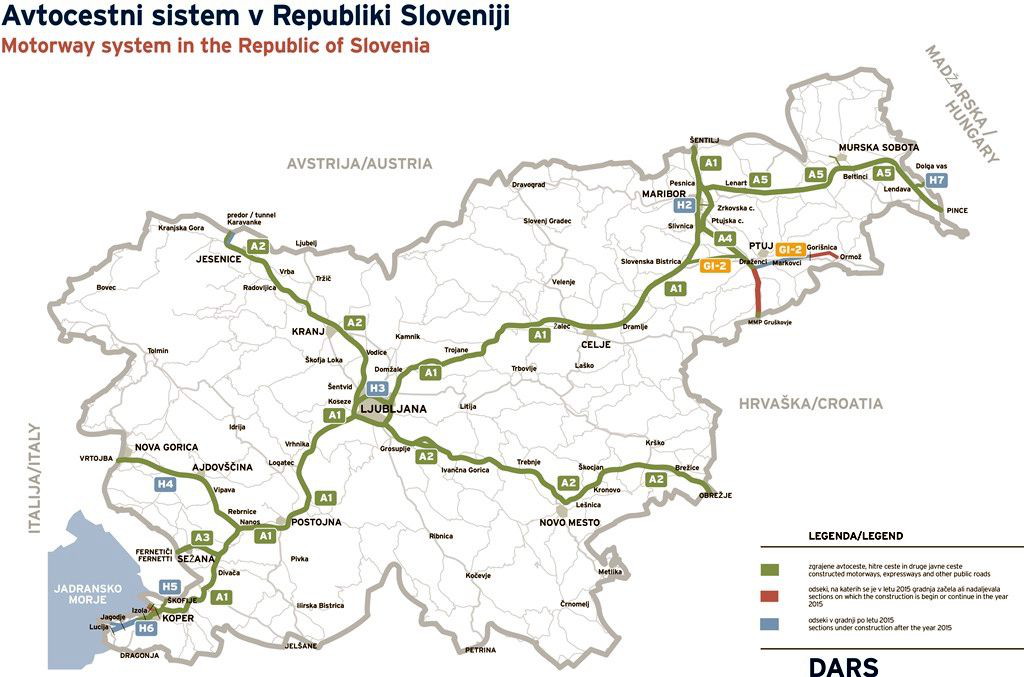
Slovenia stands at a major transportation crossroads from Central Europe towards the Mediterranean and the east. Slovenia´s road network consists of diagonally linked highways from Austria (Graz) through Ljubljana (Slovenian capital) to Italy (Trieste) and from Austria (Karavanke Tunnel) through Ljubljana to Croatia (Obrežje). The remainder of the country is also well connected with a comprehensive road and railroad system. The speed limit is 50 km/h in built-up areas, 90-100 km/h on main roads and 130 km/h on highways (for travelling on highways a yearly/monthly/weekly vignette is compulsory). Cars must use headlights at all times and either snow chains or winter tyres in winter. The alcohol limit is 0,05%. Driving in the country is easy and more convenient than relying on public transport.
Slovenia has three international airports: Jože Pučnik Airport Ljubljana (central and the biggest), Edvard Rusjan Airport Maribor and Portorož Airport. There is no train connection between the airports and nearby cities, so bus/shuttle transport or car rental is needed and easily accessible. Ljubljana airport is well connected to European destinations, while getting to Slovenia from further away usually means making a connection at a larger airport hub. A convenient option are also nearby airports in Venice, Trieste, Zagreb and Graz as they are well-connected to Slovenia with shuttle transport services. Our only port is in Koper, which easily accommodates cruise ships.
Regions & climate
Slovenia is geographically divided into alpine, prealpine, karst, coastal and subpannonian provinces. In this sense the simplified division of regions is as follows: Ljubljana (capital), Gorenjska (Upper Carniola), Primorska (Littoral Slovenia), Notranjska (Inner Carniola), Dolenjska (Lower Carniola), Koroška (Carinthia), Štajerska (Styria) and Prekmurje (the Mura river basin).
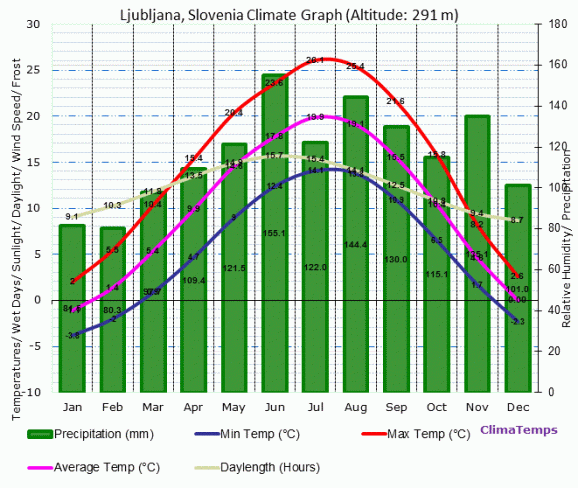
Slovenia lies in a temperate zone and has three kinds of climate. Most of the country has a temperate continental climate, where the difference between summer and winter are the most visible. Here the daytime temperatures range from 21 – 32oC in summer and -12 – 7 oC in winter. The precipitation is moderate and occurs mostly in summer. In winter the precipitation comes in the form of moderate rain, moderate snow, light snow, and light rain. The southwest of Slovenia has a mediterranean or sub-mediterranean climate, with the average winter temperature of 6°C and hot, dry summers with the average temp. of 23°C. The winters might be slightly cooler and moister than in a typical Mediterranean climate. The region has the highest number of sunniest days in the country but the temperatures are a bit lower than elsewhere in the Mediterranean. The alpine climate is typical of the alpine mountains, mountain valleys and some of the high Dinaric plateaus. In summer, when it is hot in plains, it is refreshing in the mountains. No month has a mean temperature higher than 10°C. In the valleys it is slightly warmer (reaching 20°C in summer) but here the temperature drops with elevation at a normal rate of 5.5°C per 1,000 m.

Language, money, visas
The official language in Slovenia is Slovenian. Slovenians are known for their language skills. Majority of the people understand and speak English and Serbo-Croatian. Many people speak German (especially at the border with Austria) and Italian (at the border with Italy).
The currency in Slovenia is the Euro (€). Also generally accepted methods of paying are debit or credit cards (VISA, Mastercard).
Slovenia is a member of the European Union (EU) and Schengen-agreement countries (no border control with Italy, Austria and Hungary). Many foreigners just need a passport or ID card to enter Slovenia. Those requiring a visa will be able to travel freely between the Schengen-agreement countries but for a limited time (usually 90 days).
Alcohol, smoking, tipping
By law alcohol is only sold to people over 18, although asking for an ID is rarely seen in practice. The prices of alcohol are very reasonable.
Cigarettes can´t be purchased by those under 18. Slovenia, like most EU countries, has banned smoking in public indoor spaces (that includes bars and restaurants).
In Slovenia tipping isn`t necessary and the price written on the bill is the amount of money you are supposed to pay. The waiter is always required to bring you the bill.
Security
Slovenia is one of the safest countries in the world and is regularly among top 10 safest countries according to The Global Peace Index published by the Institute for Economics and Peace. The country has a very low crime rate and it`s extremely unlikely that you will have any problems; violent crime against tourists is almost non-existent and petty crime rare. It is perfectly safe to walk outside alone at night, regardless of which region or city you are in. In the unlikely event of any dealings with the police (policija), you will generally find them easy-going, approachable and likely to speak some basic English. To call the police you must dial 113.
Opening hours and national holidays
Most shops open Monday to Friday from 8am to 7pm and on Saturdays from 8am to 1pm. The mall-type places are open on Saturdays the same as weekdays and on Sundays until 3pm. Post offices open Monday to Friday from 8am to 6 or 7pm and until noon or 1pm on Saturday. Banks are generally open from 8.30am to 12.30pm and 2 to 5pm weekdays and 8.30 to 11 am or noon on Saturdays. Pharmacies are open from 7am to 7 or 8pm weekdays. Tourist offices are open very differently, but as a rule you will find most open between 9am and 6 or 7pm. Museums are generally open Tuesday to Sunday from 9or 10am to 5 or 6pm with shorter hours in winter and longer in summer. Slovenia has 13 national holidays: January 1 & 2 (New year), February 8 (Culture day), Easter Monday, April 27 (Resistance day), Maj 1 & 2 (Labour day), June 25 (Day of Slovenian statehood), August 15 (Assumption day), October 31 (Reformation day), November 1 (All Saint`s day), December 25 (Christmas), December 26 (Independence day). Most shops and institutions are closed on these days, with the exception of big shopping malls which tend to be open a bit shorter.
Best tourist attractions
Bled lake:
Bled lake is one of the most beautiful and romantic destinations on the continent. A crystal blue glacial lake is protected by a castle on a rock above the lake which offers breathtaking views. The lake boasts an idyllic island in the middle with the church of Mary`s Assumption, which can be reached by the famous Bled wooden rowing boat known as pletna. Bled lake is simply a ferytale scene come to life.
Postojna cave:
With more than 20 km of underground corridors, halls and galleries with rich cave decorations already found within, Postojna is home to the most visited show cave in Europe. Tourist visitors can see 5 km of the cave, a part of which is travelled by electric train. Highlights of the cave include the enormous stalactites and stalagmites and a sensational concert hall which can hold 10.000 people. Words can hardly do justice to the majesty of Postojna cave.
Piran:
Piran is to the Adriatic what Bled is to the Alps. A tiny, friendly and overwhelmingly picturesque medieval town was built on a peninsula and due to its exceptional architectural heritage is in its entirety protected as a monument and is a true open-air museum. With Slovenia`s finest square and one of Europe`s most dramatically situated churches, there is plenty to fall in love with here.
Ljubljana:
Ljubljana is a vibrant and youthful capital that combines a quaint and well-kept medieval old town at its centre with more modern districts radiating out in all directions. It is best known for its squares, bridges over Ljubljanica river, buildings designed by Slovenia`s best known architect Jože Plečnik and mostly by its castle that sits atop the hill around which the city grew. Ljubljana castle offers the best panoramic view of the city. The Slovenian capital is one of the safest and cleanest cities of its size anywhere in Europe, even being named the European Green Capital of Europe in 2016.
Otočec castle:
Otočec castle is the only castle on the water in Slovenia. It is situated on a picture-perfect island in the middle of beautiful river Krka. It dates back to at least 1252 and is today a home of a five-star luxury hotel and fabulous restaurant. It is without a doubt the most romantic sight in Slovenia and that is why generations of Slovenians choose to get married here. Its location is even more charming because of the surrounding wine hills and unspoiled scenery.
Logar valley:
A truly stunning glacial alpine valley is located deep in the heart of the Kamnik-Savinja Alps. It is an excellent starting point for many gorgeous hikes. It`s wide green meadows, thick alpine forests and sloping mountains will take your breath away, but none more than the amazing Rinka waterfall. The valley is definitely a must-see Slovenian natural sight.
Škocjan caves:
A UNESCO World Heritage site, Škocjan caves are one of only three caves in the world to gain such distinction and are one of the most astounding natural attractions on the planet. They boast the largest underground canyon in the world which was formed by Slovenia`s largest underground river – Reka river. Visitors can see 3 km of the caves and admire the underground karst fairy tale scenery.
Lipica stud farm:
Lipica is famous worldwide for its Lipizzaner horses (one of the oldest cultural horse breeds in the world) and the stud farm here has over 400 years of history behind it. Lipizzaners are known for their eagerness to learn and have been well-trained in the art of dressage riding. A must-see are the presentations of the Lipica Classical Riding School and the official training sessions of the white stallions.